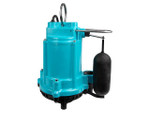
We get customers who ask if a pump is the correct size for their job all the time. It’s hard to give them a quick answer without some more details. Determining if a pump is powerful enough for your needs requires calculating your system's specific requirements and matching them to the pump's performance. If you get a pump that's too powerful for your needs can lead to serious problems like water hammer, which damages pipes, or cavitation, which destroys the pump's internal parts. On the other hand, a pump that's not strong enough won't deliver the required water pressure or flow, causing it to run longer and work harder. Both scenarios lead to premature pump failure and wasted money on repairs. The trick is to match the pump to your system's specific requirements to ensure it operates efficiently and reliably. If you get This guide breaks down the process for different types of pumps by focusing on two key factors: Total Dynamic Head (TDH) and Flow Rate (GPM).
Total Dynamic Head (TDH)
TDH is the total resistance the pump must overcome to move water. It's the sum of three components, measured in feet of head:
- Static Head: The vertical distance the water needs to be lifted.
- Friction Loss: The resistance from water moving through pipes, fittings, and valves. Use a chart or online calculator for accuracy, or estimate by adding 4 feet of head for every 90-degree elbow.
- Pressure Head: The pressure required at the end of the line, which you can convert from PSI to feet of head (Head=PSI×2.31).
Flow Rate (GPM)
This is the volume of water the pump needs to move, measured in gallons per minute.
Sizing a Sump Pump
Sump pumps are used to remove excess water from a basement or crawlspace.
- TDH Calculation:
- Static Head: Measure the vertical distance from the bottom of your sump pit to the discharge pipe's exit point.
- Friction Loss: Account for the length of the discharge pipe and any elbows or fittings.
- Pressure Head: Generally negligible for sump pumps.
- TDH=Static Head+Friction Loss
- GPM Requirements: The necessary GPM depends on how quickly water enters your pit. For most residential homes, a pump that can handle 20-30 GPM at your calculated TDH is sufficient. Consider a higher GPM if you live in an area with heavy rainfall or a high water table.
Pro Tip: Look for a pump that delivers the required GPM at your specific TDH on its pump curve. Models like the Zoeller M53 or Liberty Pumps 250 series are popular, reliable choices.
Sizing a Recirculator Pump
Recirc pumps create a loop to provide instant hot water to fixtures, reducing wasted energy.
- TDH Calculation:
- Static Head: Zero, as the water is in a closed loop.
- Friction Loss: The only component is friction loss from the pipes and fittings in the hot water loop.
- TDH=Friction Loss
- GPM Requirements: These are low-flow pumps, typically requiring only 1-5 GPM to maintain a hot water supply. The specific GPM depends on the size of your home's plumbing loop.
Pro Tip: Choose a pump designed for hot water use to prevent damage. Many recirculator pumps are small, in-line models designed for easy installation near the water heater.
Sizing an Irrigation or Booster Pump
These pumps are used to increase water pressure for irrigation systems or to boost water supply to a home.
- TDH Calculation:
- Static Head: Measure the vertical distance from the water source (e.g., well, lake) to the highest sprinkler or faucet.
- Friction Loss: Account for all pipes, valves, and fittings in your irrigation system.
- Pressure Head: Convert the desired operating pressure of your sprinklers or fixtures (e.g., 40 PSI) to feet of head.
- TDH=Static Head+Friction Loss+Pressure Head
- GPM Requirements: Calculate the combined GPM of all sprinkler heads or other devices that will run simultaneously. Manufacturers provide GPM data for each type of sprinkler head.
Pro Tip: Size your pump to meet the highest anticipated demand. For example, if you plan to run two zones at once, add up the GPM for all sprinkler heads in those two zones.
Final Step: Using the Pump Curve
Once you have your calculated TDH and required GPM, use the pump curve provided by the manufacturer. Find your TDH on the vertical axis and follow it horizontally to the pump's curve. Then, drop a line down to the horizontal axis to see the actual GPM the pump will deliver. Ensure this number meets or exceeds your required GPM.